
Following a tightly contested 2025 championship—a season that concluded with Lando Norris claiming his inaugural world title in a dramatic three-way finale—Formula 1 transitions immediately into the monumental challenge of 2026. This is not merely a new season; it is the official commencement of a new technical epoch, defined by sweeping regulatory changes designed to redefine the sport`s competitive landscape.
For the engineering departments and operational teams, the winter reprieve has been exceptionally brief. They face the arduous task of perfecting the completely redesigned “new-era” cars that must comply with rigorous new technical specifications. The resulting machinery, which debuts this year, is expected to reset the competitive equilibrium entirely, forcing every team to recalibrate its approach from scratch.
The Grid Expansion: A New Competitive Dimension
The 2026 season brings a structural expansion unseen in recent decades. The grid will officially grow to 11 teams, accommodating 22 drivers. This increase is spearheaded by two major entrants:
- Cadillac: Making their highly anticipated debut, Cadillac secures the 11th slot, marking a significant North American expansion within the sport.
- Audi: After years of planning, the German manufacturer formally takes over the Sauber operation, beginning its full factory effort under the Audi marque.
This expansion promises not only more cars on the track but a profound diversification of engineering philosophies and competitive resources. The battle for points, and indeed, for survival in the midfield, will become exponentially more challenging.
The Crucial Preseason: Technical Scouting Under Pressure
Before the season officially begins, the teams must validate their complex new designs during the preseason testing phase. The schedule is strategically divided, blending private technical work with televised public runs.
The testing schedule provides engineers with six vital days to address cooling, reliability, and fundamental car balance issues—a process complicated by the inherent unknowns of a rule change this radical.
### Closed-Door Technical Validation
The initial phase is an agreement orchestrated independently by the teams with the Spanish circuit, focusing purely on data acquisition away from public scrutiny. No timing data will be released, maintaining a veil of secrecy around early performance metrics.
January 26–30: Circuit de Barcelona-Catalunya (Four days, strictly behind closed doors)
### The Public Debut in Bahrain
The genuine first indication of the competitive pecking order will arrive during the six days of official, televised testing in Sakhir, Bahrain. Here, teams risk revealing their hand, but gain invaluable comparative data under true racing conditions.
February 11–13: Preseason testing in Bahrain (Session 1)
February 18–20: Preseason testing in Bahrain (Session 2)
The 2026 Formula 1 Grand Prix Calendar: A 24-Round Marathon
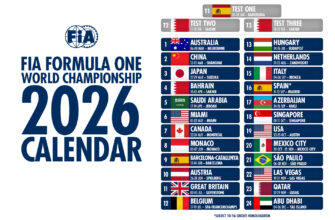
Two weeks after the final shakedown in Bahrain, the 2026 competitive season launches in Australia. The calendar features a sprawling 24-race schedule, maintaining Formula 1’s status as a premier global traveling circus. Notable highlights include increased penetration in North America and a new venue in Europe.
The United States now hosts three Grands Prix—in Miami, Austin, and Las Vegas—more than any other single nation. Furthermore, the schedule sees the addition of a new Spanish venue in Madrid, showcasing the sport`s intent to refresh its traditional European presence.
Key Dates and Sprint Weekends
This year’s schedule incorporates six highly anticipated sprint weekends, offering increased opportunities for points and, perhaps more importantly, increased drama across the race weekends.
Round 1 – March 6-8: Australian Grand Prix, Melbourne
Round 2 – March 13-15: Chinese Grand Prix, Shanghai (SPRINT)
Round 3 – March 27-29: Japanese Grand Prix, Suzuka
Round 4 – April 10-12: Bahrain Grand Prix, Sakhir
Round 5 – April 17-19: Saudi Arabian Grand Prix, Jeddah
Round 6 – May 1-3: Miami Grand Prix, Miami (SPRINT)
Round 7 – May 22-24: Canadian Grand Prix, Montreal (SPRINT)
Round 8 – June 5-7: Monaco Grand Prix, Monaco
Round 9 – June 12-14: Barcelona-Catalunya Grand Prix, Barcelona
Round 10 – June 26-28: Austrian Grand Prix, Spielberg
Round 11 – July 3-5: British Grand Prix, Silverstone (SPRINT)
Round 12 – July 17-19: Belgian Grand Prix, Spa-Francorchamps
Round 13 – July 24-26: Hungarian Grand Prix, Budapest
F1 Summer Break: A vital period for mid-season development.
Round 14 – August 21-23: Dutch Grand Prix, Zandvoort (SPRINT)
Round 15 – September 4-6: Italian Grand Prix, Monza
Round 16 – September June 12-14: Spanish Grand Prix, Madrid
Round 17 – September 24-26: Azerbaijan Grand Prix, Baku*
Round 18 – October 9-11: Singapore Grand Prix, Marina Bay (SPRINT)
Round 19 – October 23-25: United States Grand Prix, Texas
Round 20 – Oct. 30- Nov. 1: Mexico City Grand Prix
Round 21 – November 6-8: Sao Paulo Grand Prix
Round 22 – November 19-21: Las Vegas Grand Prix
Round 23 – November 27-29: Qatar Grand Prix, Lusail
Round 24 – December 4-6: Abu Dhabi Grand Prix, Yas Marina
*The Azerbaijan Grand Prix will be held on Saturday to accommodate a national day observance.
Conclusion: The Ultimate Technical Test
The 2026 season represents a pivot point in Formula 1 history. It combines radical engineering mandates with an unprecedented expansion of the competitive roster. This era promises fresh challenges, new rivalries, and a complete reordering of the established hierarchy. Teams must not only deliver fast cars but ensure reliability over a grueling 24-race schedule. For fans, the uncertainty created by the rulebook makes the start of this campaign the most intriguing in a decade, guaranteeing high stakes from the moment the new-era cars hit the track in Barcelona.