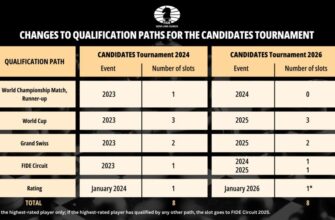

In the high-stakes world of competitive chess, few tournaments carry the weight and prestige of the FIDE Grand Swiss. As 2025 unfolds, the chess elite are once again converging, not just for prize money or rating points, but for something far more significant: a direct pathway to challenge for the ultimate title in chess. This year`s Grand Swiss, alongside the FIDE Women`s Grand Swiss, serves as a critical qualifying stage for the illustrious 2026 Candidates Tournaments, the penultimate hurdle before the World Chess Championship match itself.
The Road to the Candidates: Two Coveted Spots
For any aspiring World Champion, the Candidates Tournament is a dream, and the FIDE Grand Swiss offers two golden tickets. Held over 11 rigorous rounds, these Swiss-system tournaments are designed to test the mettle of even the most seasoned Grandmasters. It`s a grueling marathon, not a sprint, where consistent performance and nerves of steel are paramount.
The format ensures that players face a diverse array of opponents, constantly adapting their strategies. Unlike traditional round-robin events where every player meets every other player, the Swiss system pairs players with similar scores, intensifying the competition in later rounds. Every move, every decision, could be the difference between advancing towards the Candidates and watching from the sidelines. The pressure, one might say, is enough to make a King tremble.
The Marathon of the Mind: Structure and Time Controls
The FIDE Grand Swiss isn`t just a test of strategic brilliance; it`s also a battle against the clock and sheer endurance. Both the Open and Women`s sections adhere to demanding time controls, pushing players to perform under immense temporal pressure.
- In the Open section, players receive 100 minutes for their first 40 moves. Should they navigate this initial phase successfully, an additional 50 minutes are granted for the next 20 moves. The remainder of the game allows for 15 minutes, all supplemented by a 30-second increment from the very first move. This complex structure rewards both rapid calculation and thoughtful long-term planning.
- The Women`s section follows a similar demanding pattern: 90 minutes for the first 40 moves, followed by 30 minutes for the rest of the game, also with a 30-second increment per move. While slightly shorter in initial phases, the increment ensures that crucial endgames aren`t rushed into blunders.
Such regulations mean that a single game can stretch for hours, demanding peak concentration from start to finish. It’s a true test of a player`s physical stamina and psychological fortitude.
Fair Play and the AROC 1 Criterion
Beyond the clock, fairness in pairing and tie-breaking is crucial in a tournament of this magnitude. When multiple players finish with the same number of points, a sophisticated tie-break system comes into play. The primary criterion is the Average Rating of Opponents Cut 1 (AROC 1).
The Relentless Schedule
The Grand Swiss is a true test of endurance, played daily from September 4th to September 15th, with just a single day of respite on September 10th. This relentless pace means players must manage their energy, analyze their games, and prepare for the next opponent with minimal downtime. It’s a schedule that sorts the merely good from the truly great, demanding not just chess skill but also impeccable time management and psychological resilience. Imagine having to perform at your intellectual peak, day after day, with minimal breaks – it`s a challenge few professions can match.
A Dual Battle for Supremacy
It is vital to underscore that the significance of the FIDE Grand Swiss extends equally to both the Open and Women`s sections. Both tournaments offer two coveted berths in their respective Candidates events, affirming the parallel paths to the pinnacle of world chess for men and women. The stakes are identical, the pressure equally intense, and the triumphs just as profound.
Conclusion: Witnessing Chess History
As the FIDE Grand Swiss 2025 progresses, the chess world will be captivated by the unfolding drama. Each round brings new stories, upsets, and strategic masterpieces. The journey to become a World Chess Champion is arduous, beginning with events like this, where talent, preparation, and sheer willpower collide. For fans and aspiring players alike, it`s an opportunity to witness history in the making, as Grandmasters lay siege to the chessboard, each vying for their chance at chess immortality. Who will rise to the occasion? Only the 11 rounds will tell.