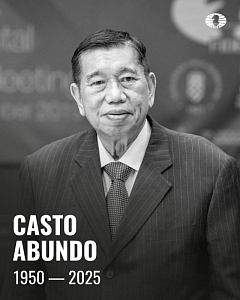
The global chess community recently registered the profound loss of Casto Abundo, the long-serving Executive Director of the Asian Chess Federation (ACF). Abundo’s career, spanning nearly five decades, was defined not by spectacular checkmates but by the rigorous, often invisible, labor of organization, technical expertise, and political negotiation. He was less a chess celebrity and more the structural engineer who ensured the rapidly expanding international chess body (FIDE) didn`t collapse under its own weight.
From his accreditation as an International Arbiter in 1978 to his final tenure guiding the growth of Asian chess, Abundo demonstrated a rare proficiency in turning chaotic major events into structured operational successes. His tenure as FIDE Secretary (1988–1990) cemented his reputation as a trusted, detail-oriented administrator capable of managing complexity, leading to crucial roles as Director and Chief Arbiter for landmark events, including the 1992 Chess Olympiad in Manila and the high-stakes 2000 World Championship.
The Era of 25-Hour Workweeks: Partnering with Campomanes
Abundo’s most defining professional chapter unfolded alongside FIDE President Florencio Campomanes. This period represented FIDE’s dramatic expansion, often conducted under logistical constraints that seem archaic by modern standards. In the absence of email or mobile telephony, the administration of global chess relied entirely on sheer human effort.
“Sometimes it amazes me when I recall how Campo and I managed the chess world without email or mobile phones. In Campo’s time, we were only four persons in the FIDE office. As Campo would say, we worked 25 hours a day, eight days a week.”
This commitment to excellence, instilled by Campomanes, required Abundo to operate not merely as a clerk, but as a crisis manager and political strategist. The depth of this working relationship was legendary, highlighting a dedication that surpassed conventional professional boundaries.
Solving the `Prima Donna Problem`: The Knockout System
Perhaps Abundo`s most consequential, yet underappreciated, technical contribution to the structure of professional chess was his proposal for the World Cup knockout system. This initiative was born out of cold political necessity. In the high-stakes environment of Candidates matches, elite players often possessed an overwhelming amount of leverage, threatening to withdraw or modify participation based on personal demands. This instability jeopardized tournament organizers and undercut FIDE`s authority.
Abundo proposed the knockout format—a sharp, quick-elimination system—as a mechanism to diffuse this disproportionate power. By rapidly rotating players and minimizing the reliance on a single, prolonged match between two individuals, the knockout system guaranteed the continuation of the event, regardless of any last-minute “prima donna” exit threats. It was a rigorous, technical solution to a fundamental problem of human ego and operational risk.
The Ultimate Chaperone: A Month with Bobby Fischer
Beyond the spreadsheets and political negotiations, Abundo occasionally found himself managing the human element at its most eccentric. One of the most telling anecdotes of his career dates back to 1976, when Campomanes sought to revive the potential match between Bobby Fischer and Anatoly Karpov in the Philippines.
Abundo was assigned the unique, month-long task of being Fischer’s dedicated escort and companion. This was an assignment requiring not only discretion but also physical endurance and an understanding of the demands of genius. The job description, as detailed by Abundo, included:
- Engaging in strenuous racquetball matches with the demanding former World Champion.
- Swimming far out into the open seas, a daily ritual.
- Serving as the driver for meetings, including trips to President Marcos’s yacht.
- Arranging social engagements, specifically a date for Fischer with a Filipina national chess team member.
- Observing Fischer`s nocturnal habit of intensely replaying games from Chess Informant.
This period perfectly encapsulated Abundo’s utility: he was the person capable of maneuvering through the high-level bureaucracy and the volatile psychology required to keep world chess functioning.
A Foundational Legacy in Asia
In his later years, Abundo channeled his vast organizational experience back into continental development. As Vice-President and eventually Executive Director of the Asian Chess Federation, he moved decisively to strengthen the ACF’s institutional framework. Recognizing the massive potential in Asia, he implemented groundbreaking initiatives that standardized operations, fostered unity among national federations, and, crucially, created a solid and sustainable foundation for chess growth in the region.
Casto Abundo’s death is acknowledged as a significant operational loss to global chess. His professional legacy is a testament to the fact that the health of a major sport relies heavily on the diligent, often thankless, work of technical experts—the people who design the systems, solve the crises, and manage the personalities, ensuring that the game itself can proceed without political interruption.